Pooja Room & Mandir Design Ideas for Pune Apartments (2026): Vastu, Placement, Materials & Cost
Key Takeaways
- Best direction: north-east (Ishan) is ideal; place idols on the east/west wall so you face east or north while praying.
- No spare room? No problem: a wall unit, a carved niche, a corner mandir or a designed shelf works beautifully in compact Pune flats.
- Materials: moisture-resistant ply + veneer body, a wooden/MDF jali backdrop, and a marble or Corian platform for the deities and diya.
- Hard rules: never share a wall with a toilet, never under a staircase, and keep it above floor level and clutter-free.
- Cost in Pune (2026): ₹15,000–45,000 for a wall unit, ₹45,000–90,000 mid-range, ₹1,00,000–2,50,000+ for a full marble pooja room.
In most Pune homes the mandir is the first thing that goes up and the last thing anyone wants to get wrong. It carries a lot — daily ritual, festivals, the family's sense of the home being settled — and yet in an apartment you usually have to create it without the luxury of a separate room. The good news: a well-designed pooja space doesn't need four walls. It needs the right spot, the right light, and a clean, intentional design.
Here is how we approach pooja room and mandir design for Pune apartments in 2026 — the Vastu that genuinely matters, six placement ideas that fit real flats, materials that survive the monsoon, and what it all costs.
Vastu for the pooja room — what actually matters
You don't need to memorise a rulebook. A handful of principles do most of the work:
- Direction: the north-east (Ishan) corner is the most auspicious — it gets soft morning light and is traditionally the zone of clarity. East and north are good alternatives.
- Facing: place the idols against the east or west wall so you face east or north while praying.
- Above the floor: the deities should sit raised on a platform or shelf, never directly on the floor.
- Avoid: the south-west for the mandir, placement under a staircase, and — the firm one — any wall shared with a toilet.
- Calm and clean: the space should be uncluttered, with a way to keep it tidy and, ideally, a shutter to close it at night.
If you want the broader picture of how direction and placement shape a whole home, our 10 Vastu tips for your Pune home covers entry, kitchen, bedroom and pooja placement together.
6 pooja room & mandir ideas that fit a Pune flat
1. Wall-mounted mandir unit
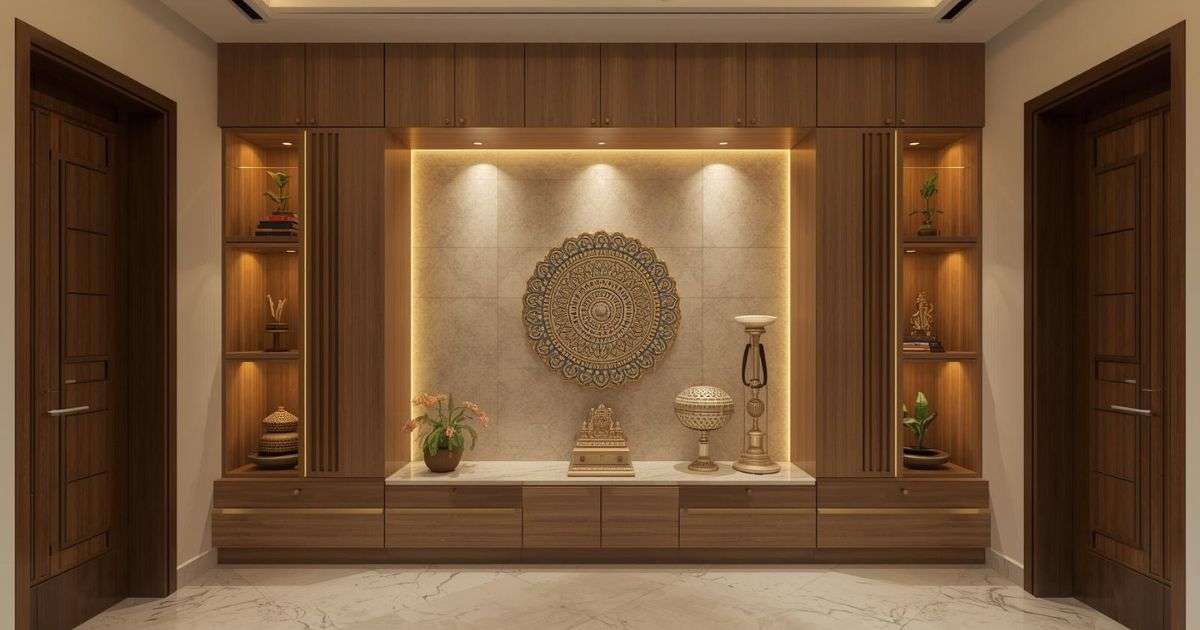
The workhorse of apartment design — a compact, wall-hung unit with a deity platform, a small jali or backlit backdrop, and a drawer or shutter below for samagri. Frees the floor, suits 1BHK and 2BHK living rooms, and can be tucked into the north-east corner of the main room.
2. Carved niche in a foyer or passage wall
If there's a blank wall by the entrance or along a passage, we recess a niche with a stone or wooden base, a jali back and a warm spotlight. It reads like a built-in temple, takes zero extra floor area, and greets you the moment you enter — ideal for compact homes, an idea we lean on in our small 1BHK ideas guide.
3. Corner pooja unit
A floor-standing or semi-tall corner unit turns an unused north-east corner into a proper mandir with storage. Great when you want presence and capacity for festivals without sacrificing a whole wall.
4. Dedicated pooja room (3BHK & bungalows)
Where there's a small store or spare room in a 3BHK or bungalow, a dedicated pooja room with a marble platform, carved wood, a jali door and layered lighting is the premium option. We detail how a room like this fits a larger fit-out in our 3BHK interior design cost guide.
5. Integrated into a crockery or TV unit
In open-plan flats, a pooja shelf can be designed into the dining-side crockery unit or a partition, set behind a sliding jali or fluted-glass shutter that conceals it when not in use. Seamless, and it keeps the living area uncluttered.
6. Kitchen-adjacent pooja niche
Common in Maharashtrian homes — a small niche near the kitchen for daily worship. It works as long as it is well away from the sink and stove and kept scrupulously clean. Pair the material choices with those in our modular kitchen materials guide.
Materials, jali & lighting
A mandir lives at the intersection of devotion and daily wear — fire from diyas, oil, water, and constant handling. Material choices should respect that:
- Body: solid wood or BWP/moisture-resistant plywood with a warm veneer or PU finish — durable and dignified.
- Backdrop: a CNC-cut or hand-carved jali in wood or MDF, often backlit, is the signature 2026 look — intricate but clean.
- Platform: marble, granite or Corian for the deity base and diya area — heat-tolerant, non-staining and wipeable.
- Detailing: brass bells, a brass or antique-finish diya stand, and a subtle gold or warm-metal accent tie it to a traditional palette.
- Lighting: warm white (2700–3000K) cove or backlight behind the jali, plus a small focused spot on the deities. Avoid cold, clinical light here above all rooms.
Pune's monsoon is hard on woodwork, and a diya zone adds heat and soot — so the same discipline from our monsoon-proofing guide applies: moisture-resistant ply, a stone platform you can wipe, and good ventilation so smoke and humidity don't sit in the unit.
Do's & don'ts at a glance
| Do | Don't |
|---|---|
| Place in the north-east, east or north | Put the mandir in the south-west corner |
| Raise deities on a platform or shelf | Place idols directly on the floor |
| Use warm, soft lighting | Use harsh, cool-white light |
| Keep it clean, calm and uncluttered | Share a wall with a toilet or place under stairs |
| Add a shutter/door to close it at night | Point your feet toward it while sleeping (if in a bedroom) |
| Keep chipped or broken idols out | Store clutter or non-pooja items in the unit |
What a pooja room / mandir costs in Pune (2026)
Ranges below are typical Pune 2026 prices for custom work, including material, carving and lighting. The big swings come from stone vs wood, the amount of jali/carving, and whether it's a unit or a full room.
| Option | Approx. cost (2026) | Best for |
|---|---|---|
| Ready-made wooden temple | ₹5,000 – ₹30,000 | Rentals, quick setups |
| Wall-mounted mandir unit (custom) | ₹15,000 – ₹45,000 | 1BHK / 2BHK living rooms |
| Mid-range unit + jali + storage + lighting | ₹45,000 – ₹90,000 | Most 2/3BHK flats |
| Niche / corner unit with stone base | ₹40,000 – ₹1,10,000 | Foyer, passage or open-plan homes |
| Dedicated pooja room (marble + carved wood) | ₹1,00,000 – ₹2,50,000+ | 3BHK & bungalows |
This usually sits inside the broader interior budget rather than standing alone — see how rooms and units add up in our 2BHK cost guide and 3BHK cost guide for Pune.
"A mandir doesn't need to be big — it needs to be honest. The right corner, warm light and a clean platform do more than the most ornate unit in the wrong place."
Krafts by Omkar Designs
Designing pooja spaces across Pune
We design and build mandirs and pooja rooms as part of turnkey interiors throughout Pune and PCMC:
- Interior designer in Kharadi — township 2/3BHKs with built-in pooja units
- Interior designer in Hadapsar — Magarpatta & Amanora apartments
- Interior designer in Wakad — compact IT-corridor flats
- Interior designer in Baner — premium homes with dedicated pooja rooms
- Interior designer in Koregaon Park — bungalows and bespoke mandir design
- Interior designer in Pimpri-Chinchwad — family homes balancing tradition and budget
Want a mandir that fits your home and your faith?
At Krafts by Omkar Designs, we design Vastu-aligned pooja spaces — from compact wall units to full marble pooja rooms — with carved jali backdrops, warm lighting and monsoon-safe materials. Layout, 3D visualisation, modular execution and finishing under one roof, with transparent pricing.